
PSHE at Chapel Hill
What is the vision of PSHE at Lee Chapel?
Aims
PSHE stands for Personal, Social, Health and Economic Education. RSE stands for Relationships and Sex Education. Chapel Hill follows Kapow’s RSE & PSHE scheme of work which supports whole-school development by providing a clear, consistent and well-sequenced approach to a subject that is central to safeguarding and personal development.
Kapow covers the full breadth of learning pupils need to stay healthy, safe and prepared for life. This includes:
- Personal.
- Social.
- Health.
- Economic.
- Relationships.
- Citizenship.
- Sex education (optional).
Our vision at Chapel Hill Primary School is for all children to develop an understanding of the ever-changing world in which we live, developing the skills necessary to take an active role in their community and manage their life effectively. It is our aim to provide a balanced and broad curriculum that enables our children to make healthy choices in order to promote their personal health and wellbeing.
Our Approach
Kapow Primary is taught weekly for 30-45 minutes per week. This allows sufficient time to meet the DfE’s Relationships Education, Relationships and Sex Education (RSE) and Health Education guidance. This recommendation is also informed by market research, which shows that many schools structure their RSE & PSHE provision in this way. Much of pupils’ learning in RSE & PSHE is not captured through written outcomes. Instead, progress is often evident through pupil talk, class discussions, role play. Lessons are recorded in class using a floor book to document group learning journeys, record student thoughts, and encourage inquiry-based learning.
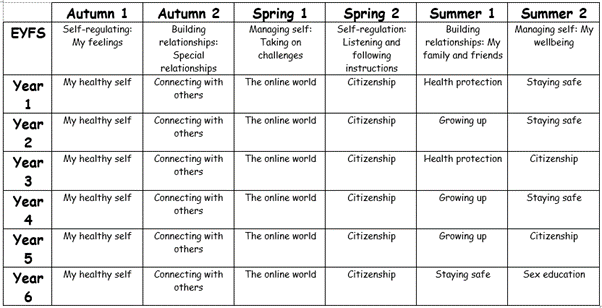
The six Kapow units are taught as follows:
In addition to Kapow, RSE & PSHE learning is often reinforced through day-to-day school life. Teachers will naturally revisit and apply their learning in response to real-life situations that arise, such as issues on the playground, in the classroom or during discussions, helping pupils to make meaningful links between taught content and real experiences.
The lessons are taught by the class teacher or other suitable teaching practitioners. Across the year, specialist PSHE days/weeks are held: Safer Internet Week, Anti-Bullying Week and Mental Health Day are to name a few. Specialists and outside agencies may at times deliver important lessons during assemblies and circle time and include (but not limited to) fire brigade, police, coastguards, local community projects and groups including religious organisations.
Impact
Kapow Primary’s RSE & PSHE scheme supports whole-school development by providing a clear, consistent and well-sequenced approach to a subject that is central to safeguarding and personal development. The lessons include ongoing assessment opportunities, such as questioning, retrieval practice and interactive activities. These tools allow teachers to assess understanding in real-time and adjust their teaching accordingly.
Pupil Outcomes
Through the implementation of Kapow, children will have a greater understanding of our world by teaching them skills like perseverance, conflict resolution, self-management and teamwork. The curriculum is designed to support pupils’ confidence, wellbeing and the way they interact with others in everyday situations.
These aspects of learning develop gradually over time and can be harder to measure. When taught consistently as part of a well-sequenced curriculum, we will notice changes in pupils’ attitudes, choices and behaviour across school life. Over time, pupils may show increased confidence in expressing feelings, asking for help and making decisions. They begin to develop self-awareness and emotional literacy, which supports resilience when facing challenges or change. Pupils may become better able to manage behaviour and responses, especially in challenging situations. They gain an understanding of why rules are vital for ensuring their own safety and that of others, and learn how to follow them.
Over time, pupils can develop resilience by learning to cope with setbacks, manage their emotions, make amends and move forward positively, thereby supporting a calm and safe school environment.